
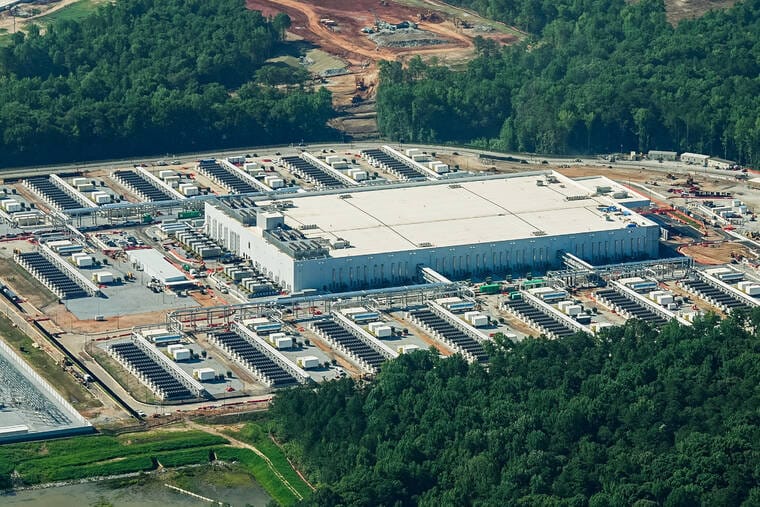
AI data center protests are spreading across the United States as opposition to the country’s rapidly expanding artificial intelligence infrastructure moves beyond local town halls and community meetings.
Protests were planned in at least 125 locations across the United States on Saturday, marking the first coordinated national effort against the accelerating construction of data centers. The demonstrations reflect growing frustration over the pressure these facilities may place on electricity prices, water supplies and local communities.
The protests are being coordinated by HumansFirst, a grassroots organization that describes the current expansion as an “unaccountable” buildout taking place without sufficient public oversight.
AI Data Center Protests Spread Across the US
Until now, much of the resistance to new data centers has been led by individual towns and counties. Residents have challenged projects over their environmental impact, resource consumption and the way local authorities approve them.
In some communities, officials reportedly signed non-disclosure agreements with developers while projects were being considered. That has fueled concerns that decisions affecting local resources are being made without enough transparency or public involvement.
The demonstrations suggest that these separate local disputes are beginning to form a broader national movement.
Texas, one of the country’s largest data center markets, was expected to host 16 protests. Georgia had 11 planned demonstrations, while California, Florida and Pennsylvania each had seven.
AI Data Center Protests Cross Political Lines
Resistance to data center development is attracting people from across the political spectrum.
HumansFirst co-founder Amy Kremer, a former Tea Party leader, compared the movement’s early momentum to the conservative uprising that emerged in 2009. However, organizers say concerns about data centers are not limited to one political party.
A Reuters/Ipsos poll conducted in June found that only one-third of Americans approved of the current pace of data center construction. Just 14% said they would support having a data center built in their own community to power AI projects from companies such as Meta, Google, Amazon, Microsoft or xAI.
The findings point to a widening gap between national enthusiasm for artificial intelligence and local support for the infrastructure required to run it.
Water and Electricity Are Driving the Backlash
AI data center protests are being driven largely by concerns about electricity and water consumption. Modern AI systems require enormous computing capacity, while the facilities supporting them can consume large amounts of energy and water for cooling.
Those demands are becoming increasingly controversial in places already facing strained power grids or limited water supplies.
In California’s Imperial County, protesters are opposing a proposed facility that could use approximately 260 million gallons of water annually from the Colorado River. For residents in a region where water scarcity is already a serious concern, the project has become a symbol of the trade-offs involved in expanding AI infrastructure.
Higher electricity bills are another major concern. As technology companies compete to build larger computing facilities, residents fear that the cost of upgrading power grids and meeting rising demand could eventually be passed on to households.
The data center industry maintains that its water use is smaller than that of several other industries and says operators are committed to acting as responsible members of the communities where they build.
Communities Want More Control Over AI Infrastructure
Organizers behind the AI data center protests are calling for greater transparency, stronger environmental safeguards and clearer benefits for the communities hosting these projects.
Their demands include well-paid local jobs, protection of water and energy resources, and mechanisms to hold developers accountable when promised benefits are not delivered.
Organizers have not universally supported stopping construction altogether. Instead, many want residents to have a meaningful role in deciding where data centers are built and what conditions companies must meet.
That distinction could become important as state and federal politicians respond to growing voter pressure.
The AI Boom Is Becoming a Local Political Issue
The artificial intelligence race is often presented as a competition between technology companies or between countries. But the infrastructure behind that race is built in real communities, where its costs are becoming increasingly visible.
The backlash also comes as experts and governments raise broader concerns about the speed of AI development. A recent UN report warned that unchecked AI progress could create serious global risks.
Data centers bring investment, construction projects and potential employment. They can also require substantial amounts of land, electricity and water, while permanently changing the areas where they are built.
As AI companies demand more computing power, resistance to the facilities supporting them is likely to intensify. What began as a series of isolated local disputes could now become one of the first major political movements shaped directly by the physical expansion of artificial intelligence.
For the AI industry, the challenge may no longer be simply finding enough land and energy to build. It may also be convincing Americans that the benefits of the AI boom are worth bringing its infrastructure into their own communities.
Source: Reporting by Reuters, published July 18, 2026.


